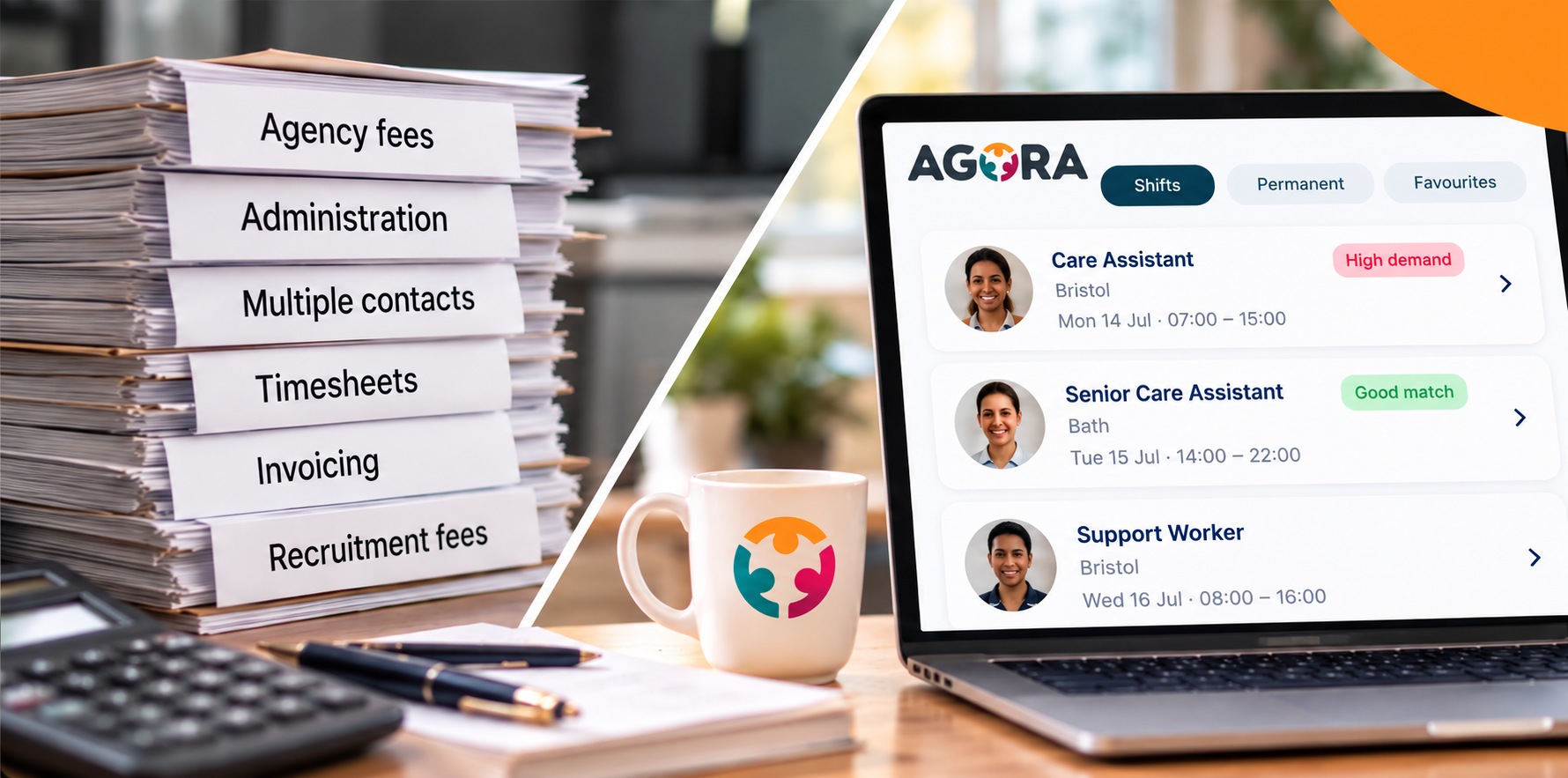
The Hidden Cost of Traditional Agency Staffing
When a care provider books an agency worker, the hourly rate is the most obvious cost.
But it isn’t necessarily the only one.
Behind every agency booking sits a considerable amount of administration: account managers, recruiters, telephone calls, availability checks, timesheets, invoicing and payroll.
Traditional staffing businesses have historically needed that infrastructure because there was no easy way for thousands of employers and workers to connect directly.
Technology is changing that.
What happens when the middle layer becomes software?
A digital marketplace can automate much of the work that once required somebody sitting at a desk.
Providers can advertise a shift directly.
Available workers can see it immediately.
Compliance information can be held digitally.
Bookings can be managed through the platform.
Work history can follow the worker.
Over time, even matching can become increasingly intelligent.
The result is a fundamentally different cost structure.
Lower costs without simply paying workers less
There is an important distinction here.
Reducing staffing costs shouldn’t have to mean reducing what care professionals earn.
If technology can reduce the administrative cost sitting between the organisation purchasing care staffing and the individual delivering it, there is an opportunity to create a better deal for both sides.
That is one of the principles behind Agora.
Our current fee for temporary staffing is just 5%, substantially changing the economics compared with many traditional staffing arrangements.
Staffing infrastructure for a digital economy
Other industries have already moved towards platforms that connect buyers and sellers directly.
We believe staffing will increasingly follow the same path.
Agencies solved a genuine problem: how do you find somebody available to work?
Digital marketplaces can solve that same problem at vastly greater scale.
And when technology does more of the administration, more of the money spent on staffing can remain where it belongs — with care organisations and the people delivering care.