For care providers, staffing is both the biggest cost and the biggest pressure point. With wages rising, National Insurance increasing, and ongoing recruitment shortages, temporary staff are often essential to keep homes running safely and compliantly.
But here’s the challenge: local authority reimbursement rates don’t reflect the real cost of temporary staffing.
Council Reimbursement vs. Real-World Costs
Take Cornwall Council’s latest schedule as an example:
- Providers are reimbursed £24.42 per hour for each staff hour of care delivered.
- But temporary staff often cost more – typically £30–£35 per hour in areas of high demand.
That leaves providers covering the difference from their own pockets. At £30 per hour, that’s a loss of £5.58 per hour of care.
What That Deficit Looks Like Over a Year
Let’s put this into perspective for a typical 50-staff care home:
- Average temporary staffing need: 10% of the workforce
- That’s the equivalent of five full-time roles covered by temporary staff across the year.
- At £30/hour, the total annual cost = £312,000
- But the council reimbursement at £24.42/hour only covers £253,968.
That leaves the provider to absorb a £58,032 annual shortfall – simply for meeting safe staffing levels.
Why This Matters
Temporary staffing isn’t optional. With vacancy rates at 10% and churn at 30%, every provider will face rota gaps. But when reimbursement rates don’t cover the true cost, providers are left with limited options:
- Absorb the deficit (weakening financial sustainability)
- Cut costs elsewhere (risking care quality or compliance)
- Or, in the worst cases, face insolvency or closure
A Smarter Way Forward
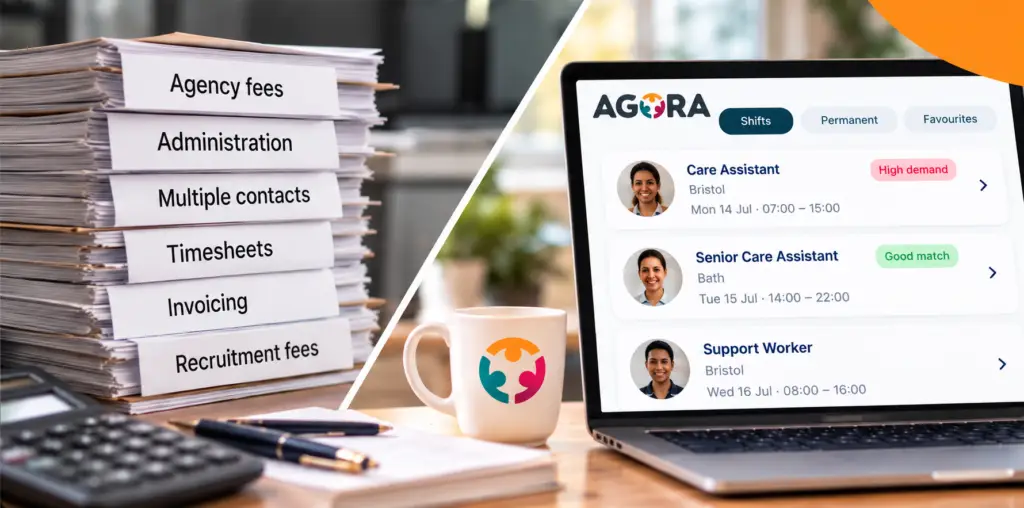
Temporary staffing doesn’t have to be a drain. By using tech-enabled staffing platforms like Agora, providers can:
- Access vetted, compliant carers at fair and transparent rates
- Pay around £15/hour + 5% commission, which sits comfortably within reimbursement rates
- Eliminate the annual deficit caused by inflated temporary staffing costs
Instead of losing £58,000+ per year, providers can turn that into a saving – funds that can be reinvested into wages, training, facilities, and long-term stability.
The funding squeeze on adult social care isn’t going away. But while providers can’t control local authority rates, energy costs, or food bills, they can control how they manage their staffing.
By tackling temporary staffing costs strategically, providers protect their margins, avoid deficits, and strengthen their resilience against wider financial pressures.
Agora is more than a tool to fill shifts – it’s a smarter, sustainable solution to one of the sector’s biggest financial challenges.
🔗 Register today at www.agorastaff.com